nice troll, but i’m actually going to take the bait, because i have something to say that i don’t think has been said enough.
what happened on we bear bears mattered. i’m not going to say it didn’t. seeing two female-presenting characters together in wedding dresses heavily implies a gay wedding, and that’s good. even if it was just for a second.
that being said – i’m going to argue steven universe gives us something else.
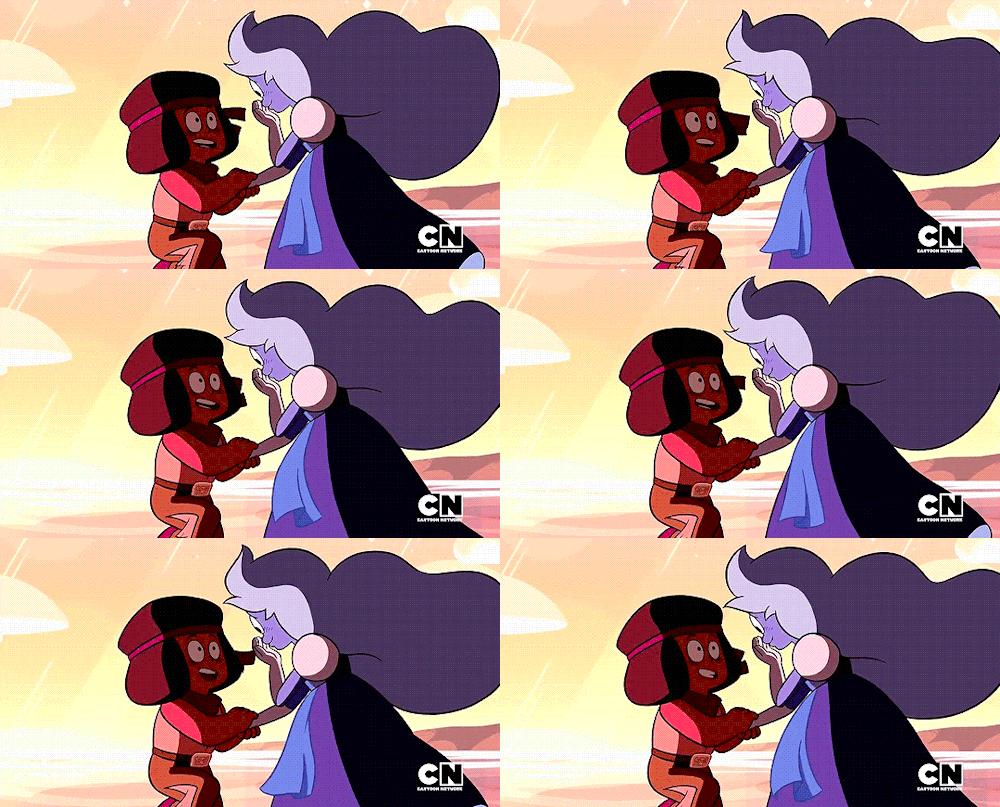
ruby and sapphire (”rupphire”) are a maturing lesbian couple we follow throughout the show. both characters can struggle with their own mental health, the difficulty of being a leader, and even argue (on rare occasion)… but fundamentally, they’re a healthy, loving couple. we, the audience, grow to care about them – both as characters and as a relationship.
in other words, the rupphire wedding doesn’t just matter because it’s a lesbian wedding. it matters because of its context – seeing two beloved characters committing to each other on their own terms.
the distinction between these two shows reminds me of how, in the political realm, we have concepts of formal vs substantial representation.
the common example is women in government – formal representation just means the woman is present, while substantial representation refers to the woman advocating for the rights & interests of women. does a woman being a woman matter, or is it a formality?
if we were to shift “formal” vs. “substantial” representation from politics to television, we could substitute “formal” with the term token. in this context, “substantial” would be expanded to when we’re not just seeing gay characters exist, but that their perspective matters. we see a gay story.
in we bear bears, we are not seeing a gay story. in svtfoe – for that matter – we are not seeing a gay story. in gravity falls, we are not seeing a gay story.
in steven universe, we are seeing a gay story.
ruby and sapphire – good apart, but even better together – fuse into one being to face any obstacle in their way.
many shows have gay moments, but not gay characters you actually care about. the company’s economic bottom line means that while you might “get away” with including little moments – that’s never the main characters. it’s never the draw of the show.
token-ish representation isn’tnecessarily a bad thing – often, it’s an important step in in the right direction. daron nefcy telling her animators to “go ahead and make some of the background couples same-sex” is a positive step. alex hirsch saying that “gay people exist, get used to it” is a positive step.
but if a gay character shows up for just a moment, even from a sympathetic point of view, that’s not substantial representation. we don’t see through their eyes. they are perceived through their interaction with straight characters, as those are the characters the audience has grown to care about.
whether that’s a positive, negative, or indifferent reaction, it cannot be called a gay story. it’s not about gay people. the mere inclusion is more likely to be noted by older fans / bloggers who watch every episode and pay attention to details, than by kids who watch it casually.
in the case of steven universe, however, i’d argue rebecca sugar brings something much more substantial to the table: she wants to tell stories about gay characters, and have children see through their eyes.
garnet – an embodiment of healthy, lesbian love – gives advice to stevonnie, a non-binary fusion who uses they/them pronouns.
i think this is beneficial to lgbt+ children on a much wider scale. actually caring about a character who is like you and who is a greatcharacter is inspiring. it’s empowering. it gives you a sense of having a real voice.
rebecca sugar once commented that a great frustration of hers is that often, token gay characters are just “someone’s parents”. when you’re watching snow white, “you want to be snow white, not her parents”. you want to be the protagonist, and have a story & romance that’s yours.
in SU, these characters’ sexualities are explored outside just an off-hand mention or a very special episode. this means you don’t just care about them as “characters who just happen to be gay”. being lgbt is a crucial part of their story and characterization.
next to your happy rupphire, you also get a complex, bittersweet relationship between morally ambiguous lesbian & bisexual girls – pearl and rose. this love sparked a revolution, and much of pearl’s later character development.
we see gay characters express joy and sadness because of their feelings for each other. we see how those experiences affect who they are. identity and personality are weaved together, rather than just getting one without the other.
for straight kids, it also means being confronted early with caring about someone who is gay. maybe even before you know what homophobia is. this is crucial, as media exposure can help change cultural attitudes. one of the fundamental questions rebecca sugar asked herself when making the show was, “what could i have shown a hateful person, as a child, to influence them to accept people who are different?”
we need substantial representation, because the answer to that can never be “1.5 seconds of a background couple”.
I used to wear a chainmail shirt to elementary school. The teachers never knew what to do about it because there was no section in our dress code forbidding medieval armor.
… Where does an elementary school child get access to an actual shirt of chainmail sized properly for them?
Growing up as a historical reenactor meant that my parents are friends with lots of people who make chainmail. My godsister received a real rapier in fourth or fifth grade, so our unsupervised outdoor playtime was… formative.



 Overdressed & Underappreciated