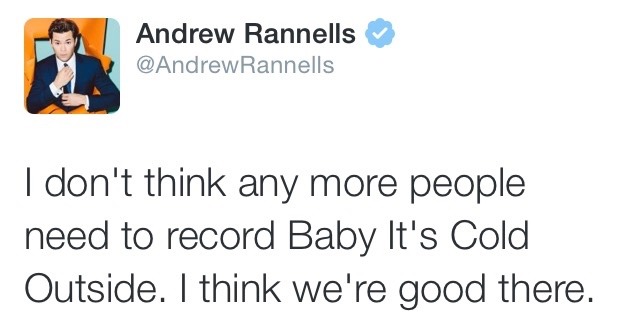
It’s time to bring an end to the Rape Anthem Masquerading As Christmas Carol
Hi there! Former English nerd/teacher here. Also a big fan of jazz of the 30s and 40s.
So. Here’s the thing. Given a cursory glance and applying today’s worldview to the song, yes, you’re right, it absolutely *sounds* like a rape anthem.
BUT! Let’s look closer!
“Hey what’s in this drink” was a stock joke at the time, and the punchline was invariably that there’s actually pretty much nothing in the drink, not even a significant amount of alcohol.
See, this woman is staying late, unchaperoned, at a dude’s house. In the 1940’s, that’s the kind of thing Good Girls aren’t supposed to do — and she wants people to think she’s a good girl. The woman in the song says outright, multiple times, that what other people will think of her staying is what she’s really concerned about: “the neighbors might think,” “my maiden aunt’s mind is vicious,” “there’s bound to be talk tomorrow.” But she’s having a really good time, and she wants to stay, and so she is excusing her uncharacteristically bold behavior (either to the guy or to herself) by blaming it on the drink — unaware that the drink is actually really weak, maybe not even alcoholic at all. That’s the joke. That is the standard joke that’s going on when a woman in media from the early-to-mid 20th century says “hey, what’s in this drink?” It is not a joke about how she’s drunk and about to be raped. It’s a joke about how she’s perfectly sober and about to have awesome consensual sex and use the drink for plausible deniability because she’s living in a society where women aren’t supposed to have sexual agency.
Basically, the song only makes sense in the context of a society in which women are expected to reject men’s advances whether they actually want to or not, and therefore it’s normal and expected for a lady’s gentleman companion to pressure her despite her protests, because he knows she would have to say that whether or not she meant it, and if she really wants to stay she won’t be able to justify doing so unless he offers her an excuse other than “I’m staying because I want to.” (That’s the main theme of the man’s lines in the song, suggesting excuses she can use when people ask later why she spent the night at his house: it was so cold out, there were no cabs available, he simply insisted because he was concerned about my safety in such awful weather, it was perfectly innocent and definitely not about sex at all!) In this particular case, he’s pretty clearly right, because the woman has a voice, and she’s using it to give all the culturally-understood signals that she actually does want to stay but can’t say so. She states explicitly that she’s resisting because she’s supposed to, not because she wants to: “I ought to say no no no…” She states explicitly that she’s just putting up a token resistance so she’ll be able to claim later that she did what’s expected of a decent woman in this situation: “at least I’m gonna say that I tried.” And at the end of the song they’re singing together, in harmony, because they’re both on the same page and they have been all along.
So it’s not actually a song about rape – in fact it’s a song about a woman finding a way to exercise sexual agency in a patriarchal society designed to stop her from doing so. But it’s also, at the same time, one of the best illustrations of rape culture that pop culture has ever produced. It’s a song about a society where women aren’t allowed to say yes…which happens to mean it’s also a society where women don’t have a clear and unambiguous way to say no.
remember loves: context is everything. and personal opinion matters. If you still find this song to be a problem, that’s fine. But please don’t make it into something it’s not because it’s been stripped of cultural context.
This is actually really interesting. I’ve never known a lot of the background to this song.
Making its annual rounds
I really appreciate Remissabyss’s contribution here. Because see, I’ve read this explanation a few times. And it is interesting historical context, and it’s good to be aware of.
But knowing that historical context does nothing at all to make me feel less creeped out by the vast majority of recordings of Baby It’s Cold Outside. Most of the exceptions are either same-sex duets or else flip the genders.
Because, you see, I’m a woman from the late 20th / early 21st century. Even though I’m fortunate enough not to have serious personal experience along these lines, the lyrics and direct exchanges between the man and the woman ping every alarm bell that I have. Taken in the context of my own time and place (which I can briefly suppress, but I can’t eliminate), they illustrate behavior that ranges from slightly skeezy to completely predatory. It doesn’t help that some of the recordings I’m most familiar with seem to go out of their way to be as sleazy as possible – the James Taylor / Natalie Cole one comes to mind.
So yes, the context is very interesting and sheds new light on the original writing of Baby It’s Cold Outside. I still don’t want to hear most versions of that song.
Volunteering at a soup kitchen is one of the least productive things you can do to change the world. Art can inspire people and motivate them. Food is important, yes, but you aren’t changing that person’s life.
whoever wrote this post has definitely never been hungry
I remember one christmas we were short on money so my brother just drew us some pictures of mashed potato it was poppin!!! We ate the pencils too!!!
…but nobody needs their introduction to fandom to be “here’s a 25,000 word fic showing you in an ABO sex pollen orgy.” And they really, really don’t need to see the accompanying artwork.
Between the various ComicCons and talk shows, if they’re potentially interested in fandom, they’ll discover it – someone who knows them personally will mention, oh hey, did you know this exists? And if their response is “yeah, I know that stuff exists; I don’t care for it,” don’t pester them about it. Those who think it’s great, will say so. Let THEM come to US, not the other way around.
I feel like this used just be a known unknown rule in Fandom but in recent years people have lost all sense of fucking boundaries. It’s very weird and unsettling
Very important rule fandoms seem to forget:
DON’T. ASK. QUESTIONS. REGARDING. SHIPS.
I have been with this show through any number of variations on Scottish or posh British accents, that time they went to fantasy Arabia, I have never had an issue with anyone going Texan or vaguely Eastern European or Pretend Irish and even the German has grown on me. But this new pirate person finally has an accent that I can’t deal with. I understand about half of what he’s saying and what is he supposed to be






 Overdressed & Underappreciated